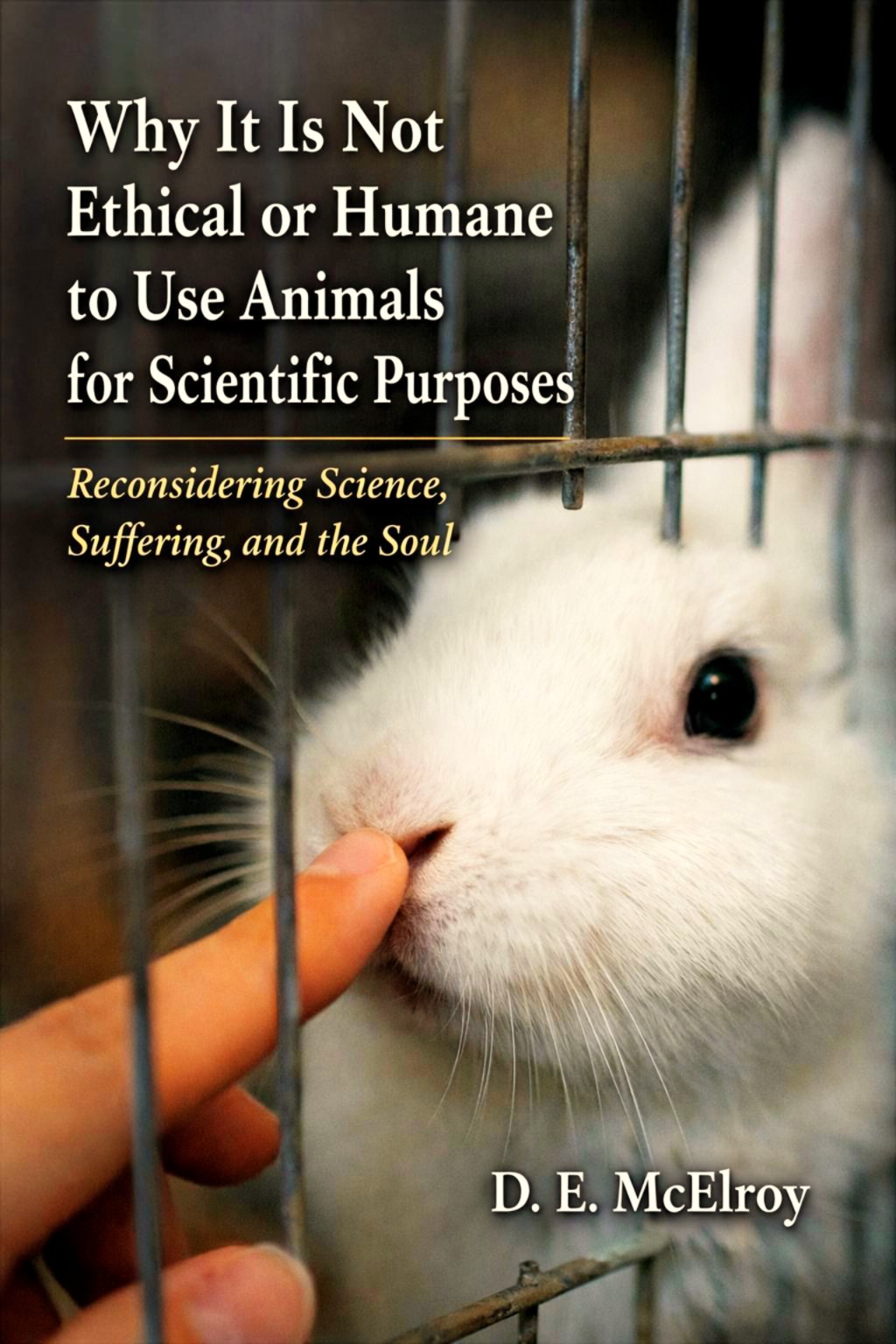
Why It Is Not Ethical or Humane
to Use Animals for Scientific Purposes
Table of Contents
- Introduction: A question of conscience, not slogans.
- Chapter 1: The Assumption Behind Animal Experimentation
- Chapter 2: Do Animals Feel? An Honest Answer
- Chapter 3: Near-Death Experiences and the Question of Animal Souls
- Chapter 4: If Animals Have Souls, What Does That Change?
- Chapter 5: Science Without Conscience
- Chapter 6: The Psychological Cost to Humans
- Chapter 7: Alternatives Exist, and Why Change Is Slow
- Chapter 8: Compassion Is Not Anti-Science
- Chapter 9: The Spiritual Cost of Using Living Beings as Tools
- Epilogue: When Science Forgets the Line
- Author Bio: About D. E. McElroy
Introduction: A question of conscience, not slogans.
Most people assume that animal experimentation is simply “the price of progress.” It is presented as normal, necessary, and beyond debate. Yet for many thoughtful people, a quiet discomfort remains: if animals are living, feeling, conscious beings, how can it be ethical to deliberately harm them for the benefit of others?
This Mini Book is not written to attack science. It is written to ask whether science can be guided by conscience and compassion—especially when the subjects of experimentation cannot consent, cannot refuse, and cannot speak for themselves.
We will look at the assumptions beneath animal experimentation, the reality of animal feeling, the implications of Near-Death Experience (NDE) testimony about consciousness, and the moral cost of normalizing suffering behind institutional language.
If the reader finishes this book and simply feels more empathy, more clarity, and more willingness to support humane alternatives, then its purpose has been served.
Chapter 1: The Assumption Behind Animal Experimentation
For centuries, the use of animals in scientific experimentation has rested on a largely unexamined assumption: that animals exist primarily as tools for human benefit. This belief is rarely stated outright, yet it quietly underpins laboratories, research grants, and institutional policies across the world. By labeling animals as “models,” “specimens,” or “biological resources,” their lived experience is linguistically stripped away before any experiment even begins.
This assumption did not arise from careful moral reasoning. It arose from convenience. When animals are defined as lesser beings, their suffering becomes easier to justify, and ethical discomfort is softened by distance. The pain is real, but the language makes it abstract. Over time, abstraction replaces conscience, and procedures that would be unthinkable if applied to humans become routine when applied to animals.
What is often missing from this framework is a simple question: What does the animal experience? Not what data is produced, not what outcome is achieved, but what the living being undergoing the experiment actually feels—fear, confusion, pain, isolation, or distress. Ignoring that question does not make it irrelevant; it merely removes it from formal consideration.
Modern society tends to assume that scientific advancement automatically carries moral authority. Yet history repeatedly shows that science progresses faster than ethics unless deliberately restrained. The presence of technical knowledge does not guarantee moral wisdom, and the ability to experiment does not automatically confer the right to do so.
Before any discussion of alternatives, reforms, or future directions can occur, this foundational assumption must be examined honestly. If animals are conscious beings capable of suffering—and increasingly, evidence and lived observation suggest that they are—then the ethical framework that permits their routine use as experimental tools deserves serious reconsideration.
Chapter 2: Do Animals Feel? An Honest Answer
The question of whether animals feel pain, fear, and emotional distress is often framed as a scientific debate, but in truth, it is largely a settled matter. Anyone who has lived closely with animals has observed their capacity for fear, attachment, joy, grief, and anticipation. These experiences are not imagined projections; they are consistent, observable behaviors expressed across species and contexts.
In laboratory environments, animals routinely display signs of distress that mirror human trauma responses. Elevated stress hormones, withdrawal, agitation, repetitive behaviors, and attempts to escape are all well-documented. These are not random reactions—they are biological and psychological responses to perceived threat and suffering. To acknowledge these signs while denying the experience behind them requires a deliberate narrowing of empathy.
Scientific literature increasingly confirms what common sense already suggests: animals possess nervous systems capable of processing pain and emotional states. Many species also demonstrate memory, learning, and expectation—key components of suffering. Pain is not merely a physical sensation; it is an experience shaped by awareness, fear, and anticipation. Animals exhibit all three.
Despite this knowledge, animal suffering is often minimized through comparison. Their pain is described as “less complex,” “less meaningful,” or “less important” than human pain. Yet suffering does not require human-level intelligence to be real. A being does not need to solve equations or use language to experience fear or distress. The ability to suffer stands on its own as an ethical threshold.
An honest answer to the question of animal feeling leads to an uncomfortable conclusion. If animals feel pain and emotional distress in ways that are meaningfully similar to humans, then their routine use in experiments that cause harm cannot be ethically neutral. Acknowledging animal feeling does not end scientific inquiry—but it does demand a serious moral reckoning with how that inquiry is conducted.
Chapter 3: Near-Death Experiences and the Question of Animal Souls
Across decades of Near-Death Experience testimonies, a consistent theme quietly emerges: consciousness is not limited to the human brain, and animals are not excluded from the larger fabric of awareness. Many individuals who have undergone NDEs report encounters with animals—often beloved pets—described not as lesser beings, but as conscious presences recognizable by their essence rather than their physical form.
What is striking about these accounts is not their emotional warmth alone, but their clarity. Experiencers frequently describe an expanded understanding in which animals are perceived as having awareness, identity, and continuity beyond physical life. In these states, animals are not seen as biological machines or instinct-driven automatons, but as living beings with their own form of consciousness.
Importantly, these testimonies arise across cultures, belief systems, and personal backgrounds. Many who report them were not inclined toward spiritual interpretations prior to their experience. Yet afterward, they often speak with certainty that consciousness does not originate in the brain and that animals participate in the same fundamental life principle as humans.
If these accounts are even partially accurate, they challenge a core assumption behind animal experimentation: that animals are disposable vessels lacking deeper significance. A being understood as possessing consciousness or soul cannot be ethically reduced to a means toward an end without moral consequence. The question is no longer merely scientific, but deeply ethical.
Near-Death Experiences do not demand blind belief. However, when many independent accounts converge on similar insights, they deserve thoughtful consideration. Ignoring this body of testimony because it disrupts long-held assumptions does not reflect healthy skepticism—it can reflect discomfort. And discomfort, when faced honestly, often signals the need for ethical growth.
Chapter 4: If Animals Have Souls, What Does That Change?
If animals are understood as conscious beings with continuity beyond physical life, the ethical landscape shifts profoundly. The question is no longer whether animal experimentation is useful, but whether it is morally permissible. Utility alone cannot justify harm when the subject of that harm is a conscious being rather than an unfeeling object.
Throughout history, societies have repeatedly revised their ethical boundaries as understanding deepened. Practices once considered acceptable—because the subjects were viewed as lesser—were later recognized as violations of moral responsibility. The expansion of ethical concern has always followed awareness, not convenience. Recognizing animal consciousness demands a similar expansion.
One of the most common defenses of animal experimentation is the claim that human benefit outweighs animal suffering. Yet this argument assumes a hierarchy of worth that has never been ethically stable. If suffering is real, then it carries moral weight regardless of the species experiencing it. Measuring worth by cognitive ability or usefulness leads to arbitrary lines that shift according to need, not principle.
Acknowledging animals as beings with souls does not require equating animals and humans in every respect. It requires something simpler and more demanding: refusing to treat conscious life as expendable. Ethical responsibility does not disappear when a being lacks language or political power. In fact, it increases.
If animals possess souls—or even a form of consciousness deserving of respect—then experimentation that causes suffering cannot be considered morally neutral. It becomes an ethical choice, one that must be justified with honesty rather than habit. Once this perspective is accepted, the conversation about animal experimentation changes permanently.
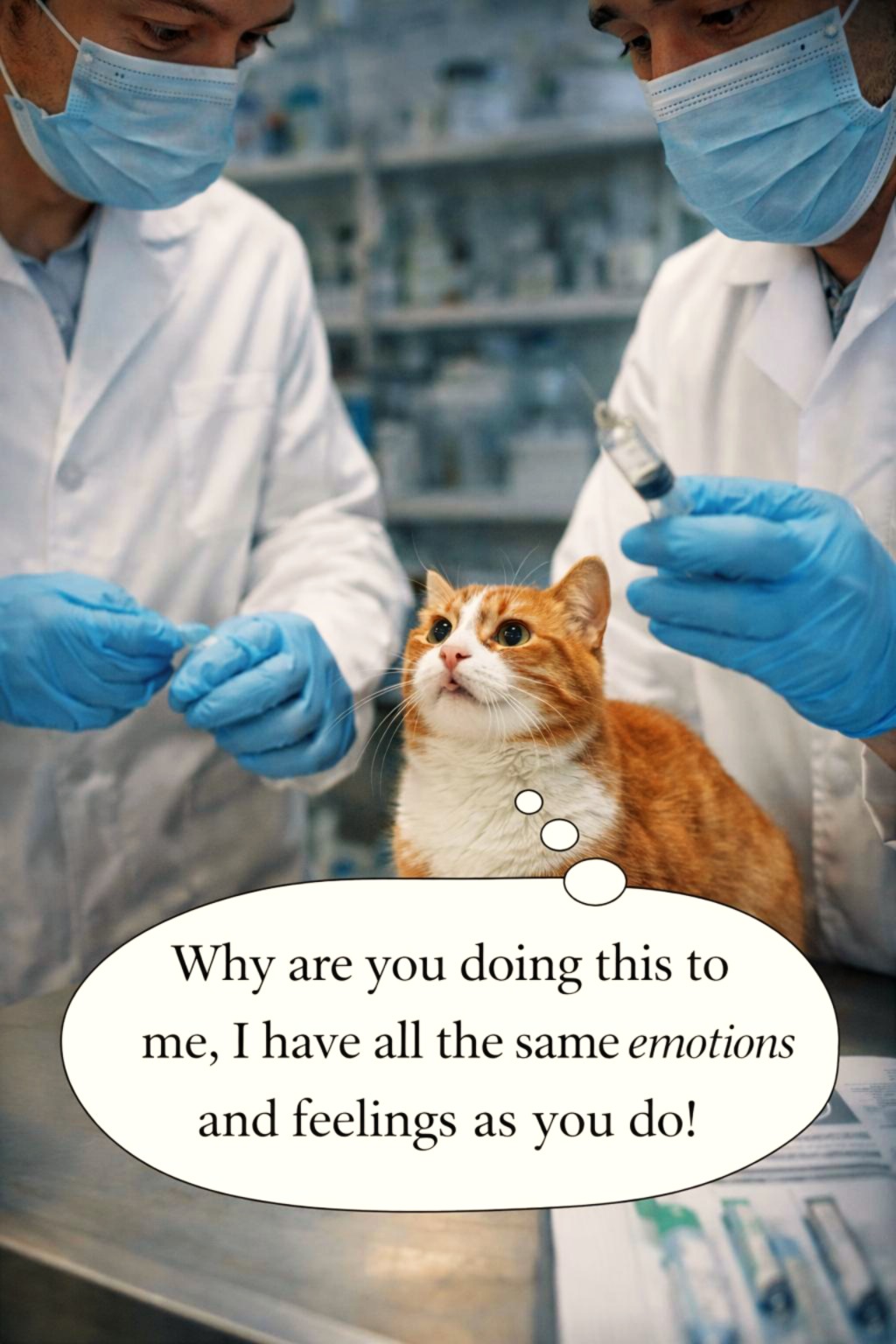
Chapter 5: Science Without Conscience
Science is a powerful tool, but it is not a moral authority by itself. Throughout history, scientific progress has often advanced faster than ethical reflection. When this happens, the pursuit of knowledge becomes detached from responsibility, and suffering is reframed as an acceptable cost of progress.
Many practices once defended as scientifically necessary are now universally condemned. They were not abandoned because they failed to produce results, but because society eventually recognized that some methods violate fundamental moral principles. In these cases, legality and institutional approval did not protect those practices from ethical judgment—only time and conscience corrected them.
Animal experimentation exists within this same ethical tension. Procedures are approved, regulated, and funded, yet approval does not equal moral clarity. Oversight committees and guidelines can reduce excesses, but they cannot resolve the core issue: whether it is right to deliberately harm conscious beings for information that benefits others.
When conscience is absent, language becomes a shield. Terms like “sacrifice,” “necessary loss,” or “acceptable harm” create emotional distance between action and consequence. This distancing allows individuals and institutions to participate in practices they might otherwise reject if confronted directly with the lived experience of the animals involved.
Science guided by conscience does not reject inquiry or discovery. It asks harder questions about methods, limits, and responsibility. When science proceeds without that restraint, it risks repeating a familiar pattern—one in which suffering is justified first, questioned later, and regretted only after harm has become undeniable.
Chapter 6: The Psychological Cost to Humans
The ethical impact of animal experimentation does not end with the animals themselves. It also affects the humans who participate in, observe, or authorize suffering as part of their professional duties. Repeated exposure to harm, even when framed as necessary, can quietly erode empathy and normalize cruelty through routine.
Researchers and technicians often enter scientific fields with curiosity, compassion, and a desire to help others. Yet over time, the requirement to suppress emotional responses to suffering can create a psychological divide. This process—sometimes called moral compartmentalization—allows individuals to perform acts they would otherwise find disturbing by separating professional responsibility from personal conscience.
Such compartmentalization carries consequences. Firsthand accounts describe emotional numbing, burnout, guilt, and internal conflict among those involved in animal testing. When empathy must be continually muted to function, it does not disappear; it resurfaces in stress, detachment, or quiet moral distress that is rarely discussed openly.
Beyond individual impact, institutional cultures can shift. When suffering becomes normalized, questioning methods may be discouraged or viewed as weakness. Ethical doubt is reframed as inefficiency, and conscience becomes an obstacle rather than a guide. In this environment, moral growth stalls—not because people lack compassion, but because systems reward silence.
A society must ask not only what it learns through its scientific practices, but what it becomes. If progress requires the routine suppression of empathy, the cost extends beyond the laboratory. True advancement should elevate humanity’s moral capacity alongside its technical skill—not diminish it.
Chapter 7: Alternatives Exist, and Why Change Is Slow
One of the most persistent justifications for animal experimentation is the claim that no viable alternatives exist. Yet this assertion is increasingly outdated. Advances in technology have produced numerous non-animal research methods, including computer modeling, organ-on-a-chip systems, advanced imaging, and human cell-based testing. These approaches often provide data that is more directly applicable to human biology than animal models.
Despite these advances, institutional momentum favors existing practices. Research infrastructure, funding pathways, and professional training are deeply invested in animal-based methodologies. Changing direction requires not only technological adoption but cultural and bureaucratic shifts—changes that large systems historically resist.
Economic factors also play a role. Entire industries supply, house, and manage laboratory animals. Grant structures, regulatory frameworks, and career advancement systems often reward continuity rather than innovation. As a result, methods persist not because they are superior, but because they are familiar and financially supported.
Ethical reform frequently lags behind capability. Even when alternatives reduce suffering and improve accuracy, they may be dismissed as unproven simply because they challenge entrenched norms. This creates a paradox: science values innovation, yet resists it when innovation threatens established practices.
Recognizing that alternatives exist removes a crucial moral excuse. Once suffering is no longer necessary for discovery, continuing harmful practices becomes a choice rather than a constraint. Ethical progress begins when institutions are willing to reexamine not just what they can do, but what they should do.
Chapter 8: Compassion Is Not Anti-Science
A frequent response to criticism of animal experimentation is the claim that ethical concern threatens scientific progress. This framing creates a false choice between compassion and discovery, as though caring about suffering requires abandoning knowledge. History suggests the opposite. Many of the most meaningful scientific advances emerged when ethical limits forced deeper creativity rather than complacency.
True science is not defined by the absence of restraint. It is defined by curiosity guided by responsibility. When ethical boundaries are imposed, they often lead to better questions, more precise methods, and more relevant results. Compassion does not weaken science; it refines it.
The belief that suffering is a necessary ingredient of progress reflects an outdated view of both science and morality. It assumes that intelligence and innovation reach their peak only when unchecked. In reality, unchecked systems tend to repeat familiar patterns, while ethical challenges drive transformation.
Scientific integrity depends not only on accuracy, but on humility. A discipline willing to question its own methods demonstrates maturity rather than fragility. When science refuses ethical examination, it risks becoming insulated from the very human values it is meant to serve.
Compassionate science does not abandon inquiry—it elevates it. It recognizes that knowledge gained at the cost of avoidable suffering carries an ethical deficit. Progress worthy of the name advances understanding while preserving respect for life, rather than treating living beings as expendable tools.
Chapter 9: The Spiritual Cost of Using Living Beings as Tools
Beyond ethics and science lies a quieter question: what does the routine use of living beings as experimental tools do to the moral fabric of a society? When suffering is systematized and hidden behind institutional processes, it leaves an imprint not only on individuals, but on collective conscience.
Civilizations are shaped not merely by what they build, but by what they permit. Practices that normalize the instrumental use of conscious beings subtly teach that power determines worth. Over time, this lesson extends beyond laboratories, influencing how vulnerability is perceived and how easily suffering can be dismissed when it serves a perceived greater good.
From a spiritual perspective—whether one is religious or not—there is a growing recognition that life carries intrinsic value beyond utility. Many philosophical traditions, and countless personal experiences, suggest that consciousness is not accidental, nor confined to a single species. Treating life as expendable dulls sensitivity to that deeper connection.
When animals are reduced to means rather than recognized as lives with experience, a fracture occurs. The cost is not immediately visible, but it accumulates. Empathy erodes quietly, replaced by efficiency and detachment. The question is not whether society notices this loss, but how long it can ignore it.
A culture that measures progress solely by output and discovery risks losing sight of wisdom. Scientific capability expands rapidly, but moral understanding requires intentional cultivation. If compassion is sidelined in the pursuit of knowledge, the resulting progress may advance technology while impoverishing the soul.
Epilogue: When Science Forgets the Line
Suffering rarely begins with cruelty. It begins with redefinition. When a living being is reclassified as a resource, a model, or a means to an end, empathy is gradually replaced by procedure. Harm does not arrive suddenly; it becomes acceptable step by step, until what should shock no longer does.
During World War II, the world was forced to confront a devastating truth. Human beings—men, women, and children—had been used in scientific experiments without consent. They were subjected to fear, pain, and death in the name of knowledge and progress. When these practices were revealed, humanity recoiled in horror. The outrage was not rooted in a rejection of science, but in the recognition that a moral line had been crossed.
That moment in history is remembered as a warning. It revealed how easily conscience can be silenced when living beings are reduced to categories rather than recognized as lives. The lesson was never meant to apply only to one time, one nation, or one group of victims. It was meant to apply wherever suffering is justified by authority, language, or perceived necessity.
Animals used in scientific experimentation are living, breathing, emotionally sensitive, conscious beings. They experience fear, distress, and pain. They form bonds. They resist harm. Yet they cannot consent, cannot refuse, and cannot appeal to those who decide their fate. Their suffering remains largely unseen, hidden behind institutional language that dulls its reality.
If the suffering of human beings once shocked the conscience of the world because it violated an ethical boundary, then the suffering of animals deserves the same moral recognition—not because the beings are identical, but because suffering itself has meaning. Pain does not become lesser because it is endured in silence.
This book does not ask for condemnation, nor does it deny the value of scientific inquiry. It asks only for reflection—for the courage to question whether progress that depends on avoidable suffering truly deserves that name, and whether compassion might be the next step in humanity’s ethical evolution.
Compassion has never weakened civilization. It has always been the force that allowed wisdom to grow. When science remembers this, it does not lose its power. It regains its soul.
Author Bio: About D. E. McElroy
D. E. McElroy is an author and the founder of World Christianship Ministries (WCM), an outreach focused on compassionate spirituality, thoughtful inquiry, and practical encouragement that helps people live with clarity and hope.
His writing blends simple language with meaningful insight, often addressing real-life topics that can be misunderstood or overlooked—so readers can make wiser choices and support others with compassion.
Website: https://wcm.org • Contact: wcm@wcm.org