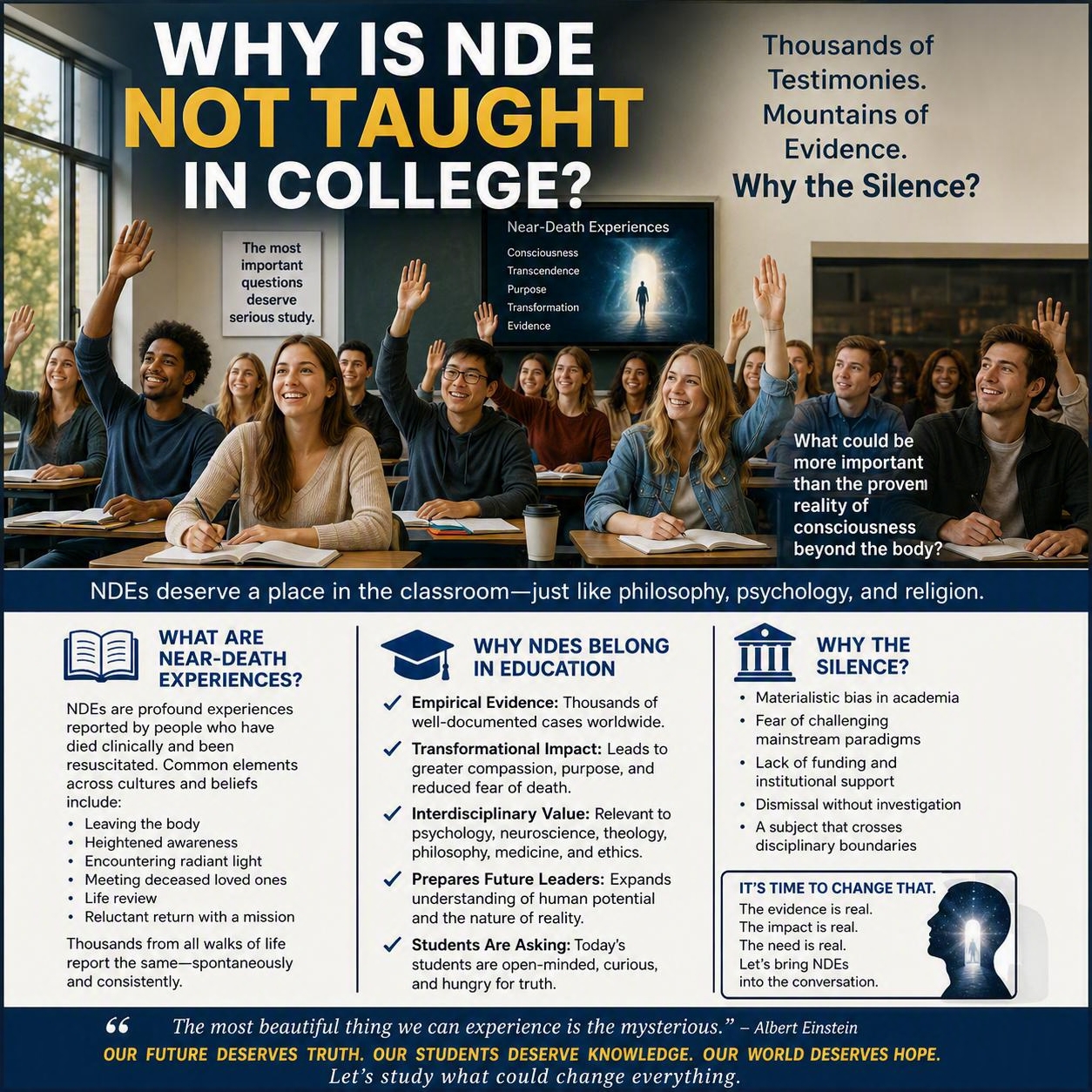
Why Aren't Near-Death Experiences Taught in Our Schools?
Table of Contents
Introduction — The Subject We Rarely Teach
Chapter 1 — What Is a Near-Death Experience?
Chapter 2 — These Aren't Just Modern Stories
Chapter 3 — Thousands of People Are Telling Us Something
Chapter 4 — The Remarkable Similarities
Chapter 5 — The Difficult Cases
Chapter 6 — What Does Science Say?
Chapter 7 — The Mystery of Consciousness
Chapter 8 — What Happens to People After an NDE?
Chapter 9 — Why Isn't This Already in the Classroom?
Chapter 10 — Teaching NDEs Is Not Teaching Religion
Chapter 11 — Imagine the College Course
Chapter 12 — Questions Students Should Be Allowed to Ask
Chapter 13 — Learning to Examine Testimony
Chapter 14 — More Than a Question About Death
Chapter 15 — Open the Classroom Door
Introduction — The Subject We Rarely Teach
Every year, students enter colleges and universities to study some of humanity's greatest questions. They study philosophy and ask what it means to exist. They study psychology and examine the human mind. They study biology and learn how the body functions. They study religion, history, medicine, neuroscience, ethics and sociology.
Yet one extraordinary human experience often receives little attention outside specialized courses and research: the near-death experience, commonly called an NDE.
People who have come close to death sometimes report experiences that seem completely different from ordinary dreams or memories. They may describe leaving their physical body, observing events around them, traveling through darkness, encountering a brilliant light, meeting deceased loved ones, experiencing overwhelming love, reviewing their lives or reaching a place that feels more real than ordinary life.
Not everyone who nearly dies reports an NDE. Not every NDE contains the same features. Researchers also continue debating what causes these experiences and what they ultimately mean.
That is precisely why they belong in education.
Education should not exist merely to teach questions that have already been answered. Some of its greatest value comes from teaching students how to examine questions whose answers remain uncertain.
This mini-book does not ask schools to teach students that NDEs prove an afterlife. It does not ask them to teach that NDEs are supernatural. And it certainly does not ask students to accept anyone else's religious or spiritual beliefs.
There are firsthand accounts, medical cases, scientific studies, competing neurological explanations, psychological theories and profound philosophical questions concerning consciousness.
Students should be able to examine all of them.
Chapter 1 — What Is a Near-Death Experience?
A near-death experience is an extraordinary conscious experience reported by people who whose body has temporarily died and the body was revived possibly on an operating table or other means.
Researchers have identified a number of commonly reported features. These can include a sensation of leaving the physical body, unusually clear thinking, movement through darkness or a tunnel, brilliant light, profound peace, unconditional love, a life review and encounters with deceased loved ones.
No single feature defines every NDE. Some people experience
only a few. Others report experiences that are very different.
Some NDEs are typically peaceful and enlightening. People who
report them usually also say they feel like they have returned
to their real home, the place where all our souls come from.
If NDEs were introduced in a college course, students would not
simply read spectacular stories. They could learn how
researchers define an NDE, how experiences are categorized and
how scientists attempt to distinguish NDE reports from dreams,
delirium, hallucinations and memories occurring during recovery.
However, our soul is not something science can research because
our soul is pure intelligent energy and can not be tested by any
scientific method. As such we rely on the vast amount of
testimonies from people who have had this temporary experience
called Near Death Experience (NDE)
In essence the Soul snaps out of the body when the body
temporarily dies and returns to where all our souls came from
briefly. Many people call it Heaven, people who experience the
NDE call it Our Real Home.
Already we have moved beyond the question, "Do you believe in NDEs?"
Those are academic questions.
Chapter 2 — These Aren't Just Modern Stories
Near-death experiences did not suddenly begin when somebody invented the term.
Stories resembling modern NDE accounts can be found in writings and traditions extending far back into human history. What changed dramatically during the twentieth century was medicine.
Modern resuscitation techniques allowed physicians to restore life to people who previously might not have survived cardiac arrest, severe trauma and other medical crises.
That created something historically unusual: growing numbers of people survived close encounters with death and were able to describe what they remembered.
Researchers eventually began studying those accounts systematically.
This gives students several interesting historical questions. Have human beings always had these experiences but lacked modern terminology for them? Have cultural beliefs shaped the way people describe them? Have modern medical conditions changed the experiences themselves? Or are we simply much better today at collecting and comparing accounts?
Chapter 3 — Thousands of People Are Telling Us Something
Individual testimony has limitations.
Human memory is not perfect. People can misunderstand events.
Expectations can influence recollections. Stories can change
with time. However, NDE testimonies seem to be remembered in
detail and not changed as time goes by. They are not forgotten
like a dream can be forgotten.
Good education should teach students all of that.
But it should also teach another principle:
Researchers do not normally dismiss large collections of reports merely because they do not yet understand their cause. They collect them, classify them, compare them and develop hypotheses that might explain them.
NDE research organizations have accumulated extensive collections of firsthand accounts that can be examined for recurring features, differences and patterns.
The educational question is not:
Of course not.
The question is:
Students could compare accounts, identify recurring features, examine differences between cultures, consider medical circumstances and learn to distinguish personal testimony from independently verifiable evidence.
That is exactly what critical thinking is supposed to accomplish.
Chapter 4 — The Remarkable Similarities
One reason NDEs continue attracting attention is the recurrence of certain themes.
People may describe leaving their bodies. Some report observing their surroundings from another location. Others describe movement toward light, encounters with deceased relatives, overwhelming peace or love, or reviewing events from their lives.
These similarities do not automatically tell us what causes
NDEs. However NDE testimonies almost always say it was caused by
the Soul "snapping" out of their body which was dead briefly.
Perhaps human brains respond in similar ways when facing extreme physiological stress.
Perhaps psychological mechanisms generate recurring patterns.
Perhaps consciousness is capable of something we do not yet understand.
Those are competing possibilities, and students should be able to investigate them.
A classroom could ask whether culture affects NDE content. Do people from different religions interpret similar experiences differently? Are there features that appear across cultural boundaries? Are childhood NDEs similar to adult experiences? Do people encounter figures they expected to encounter—or sometimes people they did not expect?
A good course would not hide inconvenient evidence from either side.
Chapter 5 — The Difficult Cases
Some NDE reports are especially challenging because experiencers claim to have perceived events occurring around them while they were severely medically compromised.
These are sometimes called veridical perception claims.
For example, someone may report observing medical personnel performing resuscitation or hearing a particular conversation.
Such cases require exceptional care.
Could the patient have heard something while partially conscious? Was information learned afterward? Could memory have reconstructed events? Are medical records available? Were witnesses interviewed independently?
Those are exactly the questions researchers should ask.
The point is not that every unusual perception must be paranormal.
The point is that unusual claims sometimes produce testable questions.
Instead of laughing at them or automatically believing them, researchers can investigate.
That attitude—neither gullibility nor automatic dismissal—is something every college student should learn.
Chapter 6 — What Does Science Say?
Science does not currently have one universally accepted explanation for every aspect of the near-death experience.
Researchers have considered many possibilities, including reduced oxygen to the brain, changes in carbon dioxide, neurotransmitter activity, temporal-lobe processes, psychological responses to extreme danger and other neurological mechanisms. Some drugs can also produce experiences containing features that resemble parts of NDEs.
Those explanations deserve serious consideration.
Other researchers argue that some reported features are not adequately explained by current neurological models. Research surrounding cardiac arrest, consciousness and remembered experiences continues.
That does not mean one side has won the argument.
It means there is an argument worth studying.
Imagine presenting different positions to students.
Study the neurological explanations.
Study the psychological explanations.
Study the cases researchers believe those explanations have difficulty addressing.
Then ask:
That is science.
Chapter 7 — The Mystery of Consciousness
NDE research leads directly into an even larger mystery:
We know that brain activity and conscious experience are
intimately related. Damage particular areas of the brain and
perception, memory, personality or behavior can change. However,
NDE testimonies say consciousness is in the Soul not the the
brain and that the brain is only a conduit for the soul to be
able to communicate and control the body.
But explaining how physical brain processes produce subjective
awareness remains one of philosophy and neuroscience's deepest
problems. Where science fails is again because the Soul is not
something that can be studied by earthly means.
How does electrical and chemical activity become the experience of seeing red?
Why does pain feel like something?
Where does our sense of being a conscious self come from?
NDEs make those questions especially interesting because experiencers sometimes report exceptionally vivid consciousness during extreme medical circumstances.
Again, students do not need to be given an answer.
Perhaps future neuroscience will explain every feature of NDEs
through brain function. However, people who experience NDE's say
it is beyond earthly science to study a Soul and it's impact on
the body.
Perhaps our present understanding of consciousness is incomplete in a more fundamental way.
Either possibility is worth investigating.
A university is precisely where difficult questions like these belong.
Chapter 8 — What Happens to People After an NDE?
One of the most important aspects of an NDE may occur after the person survives.
Many experiencers report lasting changes in their attitudes and priorities.
People may report less fear of death. Relationships can become more important. Material success may become less important. Some experiencers report increased compassion, spirituality or concern for others.
But adjustment is not always easy.
An experience that profoundly changes someone's understanding of life and death can create difficulties when friends, family members or medical professionals do not understand what happened.
That makes NDE education relevant not merely to philosophy students but potentially to future doctors, nurses, psychologists, counselors, social workers, hospice professionals and clergy.
Imagine a nurse encountering a frightened patient who says:
Education could make the difference between responding with ridicule and responding:
That alone makes the subject worth teaching. However, NDE
experiencers rarely if ever are frightened by the event. Quite
the opposite. The seem enlightened by the event.
Chapter 9 — Why Isn't This Already in the Classroom?
There probably is not one answer.
For much of modern history, NDEs have existed awkwardly between several academic disciplines.
Medicine studies the body. Neuroscience studies the brain. Psychology studies experience and behavior. Philosophy studies consciousness. Religious studies examines beliefs about death and the afterlife.
NDEs cross all of those boundaries.
The subject also carries cultural baggage. Mention experiences occurring near death and people may immediately think of religion, ghosts or the paranormal.
Scientists understandably want to protect rigorous research from unsupported claims.
But avoiding a subject entirely is not scientific rigor.
Students should learn why subjective testimony presents difficulties. They should learn about confirmation bias, memory errors, expectancy effects and inadequate controls.
But they should also learn not to use skepticism as another form of belief.
"I don't know" is sometimes the most scientifically responsible answer available.
And "Let's investigate" is usually better than "We're not allowed to ask."
Chapter 10 — Teaching NDEs Is Not Teaching Religion
This distinction is essential.
Teaching about NDEs would not require teaching that Heaven exists.
It would not require belief in God.
It would not require students to accept reincarnation, souls, spirits or any religious doctrine.
Universities already teach subjects containing profound disagreements.
A philosophy professor can teach arguments for and against free will without requiring students to adopt either position.
A religious-studies professor can teach Christianity, Buddhism, Hinduism and Islam without requiring students to join any of them.
A neuroscience professor can teach competing theories of consciousness.
NDEs can be approached in exactly the same manner.
Students could examine what people report. They could study neurological theories. They could study psychological theories. They could examine medical research. They could study cross-cultural differences. They could discuss philosophical implications.
And they could disagree.
Chapter 11 — Imagine the College Course
Imagine opening a college catalog and finding:
Near-Death Experiences and the Study of Consciousness
An interdisciplinary elective examining near-death experiences, consciousness, cardiac arrest, neuroscience, psychology, philosophy, culture and the human response to mortality.
That could be a fascinating course.
One week students might study brain physiology during cardiac arrest.
Another could compare firsthand accounts.
Another might explore cultural interpretations.
Students could read skeptical neurological explanations alongside research suggesting that conventional models may be incomplete.
Guest speakers might include physicians, neuroscientists, psychologists, NDE researchers and experiencers themselves.
Assignments could require students to argue both sides of a question.
A student who believes NDEs prove survival after death might be required to construct the strongest neurological explanation.
A skeptical student might be required to examine the strongest evidence challenging a purely neurological explanation.
Chapter 12 — Questions Students Should Be Allowed to Ask
A serious NDE course could revolve around questions rather than conclusions.
What happens to brain function during cardiac arrest?
When are NDE memories formed?
Why do some people report NDEs while others do not?
Why are certain features repeated?
How much does culture influence what people experience?
Can unusual perceptions during an NDE ever be independently verified?
How reliable is memory following severe medical trauma?
Why do some experiencers report lasting personality and value changes?
Can consciousness exist without ordinary brain function?
What evidence would be necessary to demonstrate that?
What evidence would challenge it?
And perhaps the largest question:
Those are not foolish questions.
They are enormous questions.
A student could spend an entire academic career investigating just one of them.
Chapter 13 — Learning to Examine Testimony
NDE education could also teach students an increasingly valuable skill:
The wrong approach is:
"Someone said it, therefore it must be true."
But the opposite approach is equally poor:
"That sounds impossible to me, therefore the person must be wrong."
Students could learn to ask:
How soon after the event was the account recorded?
Did the story change?
Are medical records available?
Were witnesses interviewed separately?
Could information have been obtained normally?
Does the account contain specific details or broad impressions?
Have researchers attempted replication?
What alternative explanations exist?
What evidence favors each explanation?
Those skills extend far beyond NDE research.
They are useful when evaluating news reports, scientific claims, eyewitness testimony, advertising, political statements and information encountered on social media.
Studying controversial questions can actually produce better critical thinkers because students cannot simply memorize an approved answer.
They must learn how to evaluate evidence.
Chapter 14 — More Than a Question About Death
Perhaps the most surprising lesson from NDE research is that the subject may ultimately be less about dying than about living.
Again and again, experiencers describe changes in what they consider important.
Love.
Relationships.
Compassion.
Forgiveness.
Helping other people.
Living with purpose.
That does not prove that every philosophical conclusion drawn from an NDE is objectively true.
But the transformation itself is worthy of study.
Why would an intense experience near death cause someone to reconsider decades of priorities?
Why might fear of death decrease?
Why do some people return convinced that how they treated others mattered more than their possessions or social status?
Psychologists can study those questions. Sociologists can study them. Philosophers can discuss them. Medical professionals can learn from them.
And students can ask themselves something without adopting any supernatural belief at all:
Chapter 15 — Open the Classroom Door
The proposal of this mini-book is intentionally modest.
Create elective courses.
Let interested students enroll.
Nobody is forced to participate.
Nobody is required to believe anything.
Teach the history.
Teach the testimony.
Teach the research.
Teach neurological explanations.
Teach psychological explanations.
Teach skeptical criticism.
Teach the unanswered questions.
Bring competing researchers into the discussion.
Most importantly:
Near-death experiences involve medicine, neuroscience, consciousness, psychology, philosophy, spirituality, culture, ethics, grief and our understanding of mortality.
Few subjects naturally connect so many areas of human knowledge.
Why should a curious college student not be able to spend a semester examining them?
The classroom door does not need to open toward a predetermined answer.
It simply needs to open.
Conclusion — Let Students Examine the Evidence
Perhaps one of education's greatest mistakes is not teaching something incorrectly.
It is deciding that an important question should never be examined at all.
Near-death experiences raise questions about consciousness, death, memory, perception, identity, love, purpose and the meaning people give to their lives.
Research is continuing. Questions remain unresolved. Scientists disagree about interpretation.
Good.
That means there is something to study.
Students do not need protection from unanswered questions. They need the intellectual tools to investigate them.
A college course examining NDEs should never begin:
It should begin:
Some students might finish the course believing consciousness survives physical death.
Others might conclude that neuroscience will eventually explain NDEs completely.
Others may simply say:
All three outcomes are acceptable.
Because the purpose of education is not to make every student reach the same conclusion.
It is to give them enough knowledge to reach an informed conclusion of their own.
And perhaps that is the strongest reason of all for bringing
near-death experiences into the classroom.
In general, people who have experienced a Near Death Experience
say it is simple: "The body died temporarily, the Soul left the
body and returned to our real home with consciousness intact.
But had to return to the body when the body was revived."
Resources for Further Exploration
The following organizations and research resources provide firsthand accounts, scientific research, educational material and opportunities for further investigation. Inclusion does not mean that every organization or researcher reaches the same conclusions. Readers are encouraged to examine different viewpoints and decide for themselves.
International
Association for Near-Death Studies (IANDS)
An organization devoted to research, education and support
concerning near-death and related experiences.
IANDS
— NDE Research
Research information and resources concerning near-death
experiences.
IANDS — NDE Experience Archive
A collection of near-death and related experience accounts
available for study and exploration.
Near-Death
Experience Research Foundation (NDERF)
An extensive collection of near-death experience accounts and
related research material.
University of Virginia — Division of
Perceptual Studies
An academic research division within the University of
Virginia School of Medicine studying extraordinary experiences
and questions involving consciousness.
University of Virginia — Near-Death
Experience Research
Information about the university's research into near-death
experiences, including work associated with psychiatrist and
researcher Dr. Bruce Greyson.
PubMed — Near-Death Experience Research
Search peer-reviewed biomedical literature concerning
near-death experiences.
Google Scholar — Near-Death Experience
Research
Search scholarly articles, books and academic papers
concerning NDEs and related subjects.
About the Author
D. E. McElroy writes about spirituality,
consciousness, compassion, human experience and questions that
encourage readers to think beyond traditional boundaries. His
work invites readers to explore ideas for themselves rather than
telling them what they must believe. Visit D. E. McElroys Own Near
Death Experience Research Page (Click Here)
This mini-book was created with a simple purpose: to encourage open-minded education and thoughtful examination of near-death experiences as a legitimate interdisciplinary subject worthy of further study.