Site Home
Page
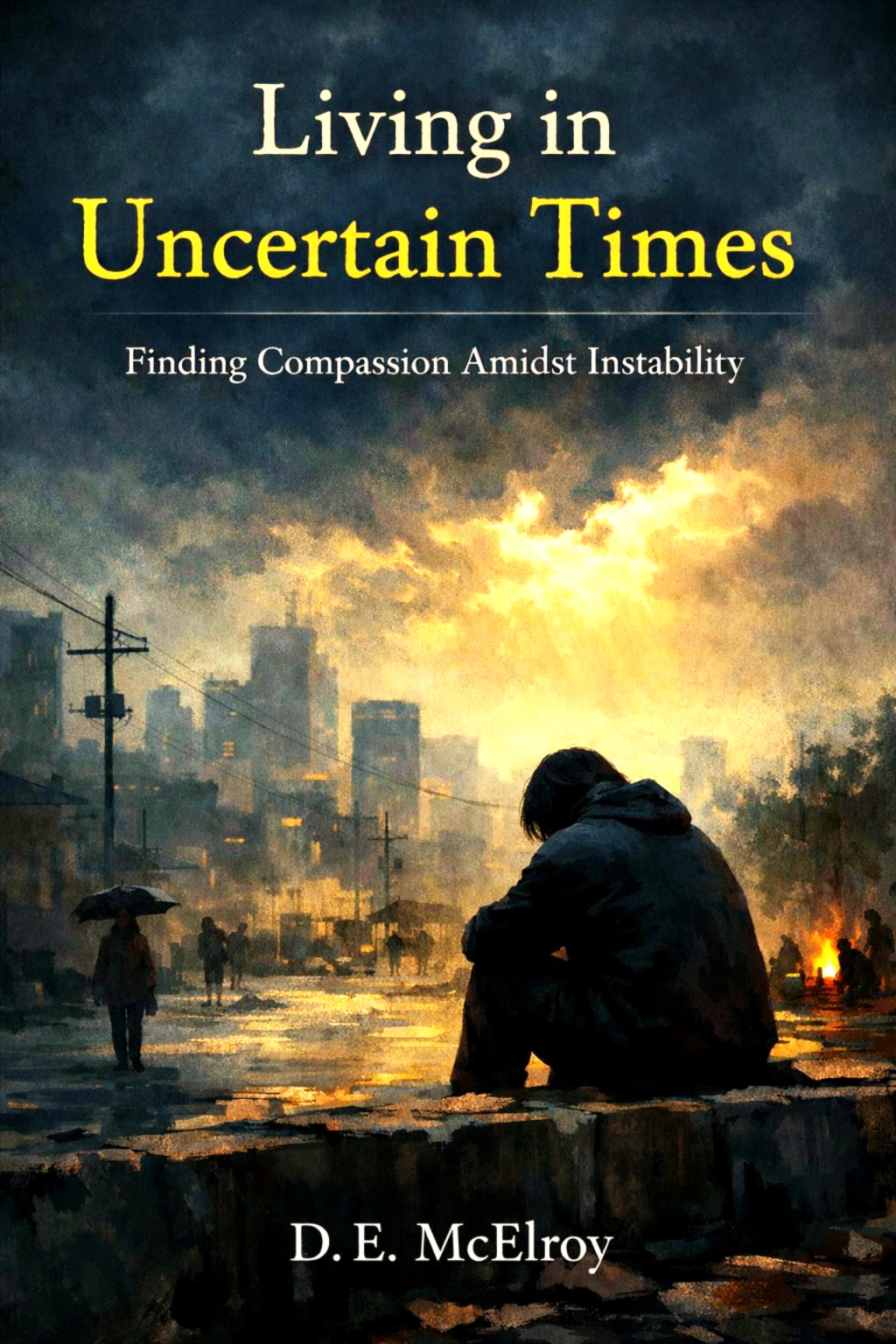

Living in Uncertain Times
Table of Contents
- Introduction — When Uncertainty Becomes a Daily Companion
- Chapter 1 — The Human Need for Stability
- Chapter 2 — Living Under Constant Psychological Tension
- Chapter 3 — Cognitive Overload and Emotional Fatigue
- Chapter 4 — The Erosion of Trust and Inner Safety
- Chapter 5 — Identity, Fear, and the Search for Certainty
- Chapter 6 — When Uncertainty Becomes Existential
- Chapter 7 — Homelessness: The Most Visible Psychological Casualty
- Chapter 8 — Trauma, Escape, and the Desire for the Pain to Stop
- Chapter 9 — The Cost of Ignoring Psychological Reality
- Chapter 10 — Compassion as Psychological First Aid
- Epilogue — Bearing Witness Without Losing Ourselves
- About the Author
Introduction — When Uncertainty Becomes a Daily Companion
Political uncertainty has become a persistent background condition in many parts of the world. Even those who try to avoid politics entirely often feel its psychological effects. The future can feel less predictable, conversations can feel more tense, and a subtle unease can settle into daily life.
This Mini Book does not examine political positions or argue for parties, candidates, or ideologies. Instead, it explores how prolonged uncertainty itself affects the human mind and spirit. Regardless of beliefs, humans share common psychological needs for stability, meaning, and safety.
When uncertainty becomes chronic, it reshapes thought, emotion, and behavior. Understanding these effects helps replace self-judgment with compassion and confusion with clarity.
The goal is simple: to name what many people feel but struggle to articulate—and to do so with empathy, dignity, and humanity.
Chapter 1 — The Human Need for Stability
Human beings are not built to live in a constant state of uncertainty. At a biological and psychological level, the mind seeks patterns, predictability, and a sense of continuity. Stability allows the nervous system to relax, the mind to plan, and the spirit to feel anchored in the world. When stability is present, people can tolerate difficulty because they trust that tomorrow will resemble today in meaningful ways.
When uncertainty becomes prolonged, however, that sense of safety begins to erode. The mind stays alert, scanning for threats that are not always clearly defined. This constant vigilance is exhausting. Even people who avoid news, arguments, and political discussion often feel its effects indirectly—through tension in conversations, shifts in social behavior, and a vague sense that something is “not right.”
Psychologically, uncertainty activates the same stress systems that respond to danger. The body does not distinguish well between physical threats and ongoing unpredictability. As a result, people may experience anxiety, irritability, difficulty concentrating, and disrupted sleep without being able to identify a specific cause. The stress feels real, but its source feels abstract.
Over time, living without a sense of stable ground can change how people relate to the world. Long-term planning becomes difficult. Trust weakens. Hope narrows. When the future feels unclear, the present becomes heavier, and even ordinary decisions can feel overwhelming.
Understanding the human need for stability is the first step in understanding why widespread uncertainty has such a powerful psychological impact. It is not a personal failing to struggle under these conditions—it is a human response to a world that no longer feels predictable.
Chapter 2 — Living Under Constant Psychological Tension
When uncertainty becomes part of daily life, the mind rarely gets a chance to rest. Even without dramatic events, the nervous system remains on alert, anticipating disruption. This low-level vigilance often goes unnoticed at first, yet it steadily consumes emotional and mental energy. People may feel tired without knowing why, or tense without being able to point to a specific cause.
Psychologically, this state resembles living with an unresolved threat. There is no clear beginning or end, no moment of relief that signals safety. Instead, uncertainty lingers in the background, shaping thoughts and emotions quietly. Over time, this can lead to irritability, impatience, and a reduced tolerance for stress in everyday situations. Small challenges feel larger than they once did.
Many individuals describe a sense of being “on edge.” Concentration becomes more difficult, decision-making feels heavier, and the mind may circle the same worries repeatedly. Even moments of calm can feel fragile, as though peace might be interrupted at any time. This constant readiness takes a toll, particularly on those who are already sensitive or empathetic.
Sleep is often affected as well. The mind may struggle to shut down, replaying concerns or anticipating future problems. Poor rest then amplifies anxiety and fatigue, creating a cycle that is hard to break. Over time, emotional resilience weakens, not because people are incapable, but because they are depleted.
Living under constant psychological tension changes how people experience the world. It narrows focus, shortens patience, and reduces the capacity for joy. Recognizing this tension as a response to uncertainty—not as a personal weakness—is essential. Only then can individuals begin to understand their reactions with compassion rather than self-judgment.
Chapter 3 — Cognitive Overload and Emotional Fatigue
In times of prolonged uncertainty, the mind is asked to process more than it was designed to handle. Conflicting information, unresolved questions, and emotionally charged messages accumulate without offering clarity or resolution. This constant intake overwhelms the brain’s ability to sort, prioritize, and rest.
When cognitive overload sets in, people often notice subtle changes first. Concentration becomes harder to maintain. Thoughts feel scattered or repetitive. Decision-making slows, and even simple choices can feel draining. The mind circles the same concerns without arriving at conclusions, creating a sense of mental stagnation.
Emotional fatigue frequently follows. When the brain is overworked, emotional regulation weakens. People may feel numb one moment and irritable the next. Empathy can shrink—not because compassion has disappeared, but because emotional reserves are depleted. This fatigue can make people withdraw from conversations, news, or even relationships they once valued.
Over time, some individuals cope by disengaging altogether. They avoid information, shut down emotionally, or distract themselves excessively. While these responses are understandable, they can also deepen feelings of isolation and helplessness. The mind is not recovering; it is retreating to survive.
Recognizing cognitive overload and emotional fatigue as normal responses to prolonged uncertainty helps reduce self-blame. These reactions are not signs of weakness or apathy. They are signals that the human mind has reached its limits and is asking for relief, clarity, and stability.
Chapter 4 — The Erosion of Trust and Inner Safety
Prolonged uncertainty does more than create stress; it slowly erodes trust. When the future feels unpredictable and explanations feel unstable, people begin to lose confidence not only in systems, but in the idea that the future itself is dependable. This loss is often quiet and gradual, showing up as caution, withdrawal, or emotional guardedness rather than open fear.
Trust plays a central role in psychological well-being. It allows people to plan, invest emotionally, and feel that their efforts matter. When trust weakens, people become more hesitant to commit—to relationships, goals, or even ordinary routines. Life begins to feel provisional, as though everything could change without warning.
This erosion of trust often extends inward. People may begin to doubt their own judgment, feeling unsure about decisions that once felt straightforward. The internal sense of safety that comes from feeling oriented in the world starts to slip. Even familiar environments can feel subtly less secure when the broader context feels unstable.
Social trust is affected as well. Conversations become more cautious. Misunderstandings feel more charged. People may interpret others’ words or actions through a lens of suspicion rather than goodwill. This is not because individuals become less kind, but because uncertainty primes the mind to anticipate threat.
As inner safety diminishes, people may retreat emotionally to protect themselves. While this withdrawal can feel like self-preservation, it also increases isolation. Understanding how uncertainty erodes trust helps explain why people may seem distant, guarded, or disengaged during unstable times. These behaviors are not moral failings; they are adaptive responses to a world that no longer feels reliably safe.
Chapter 5 — Identity, Fear, and the Search for Certainty
When uncertainty persists, the human mind begins searching for something solid to hold onto. Stability is not only external; it is also psychological. In the absence of clear ground, people instinctively look for certainty wherever it appears available, even if that certainty is rigid or emotionally charged.
This search often affects identity. Beliefs, opinions, and affiliations can become more tightly held, not because people are becoming more extreme by nature, but because uncertainty threatens a basic sense of self. When the world feels unstable, identity can feel like the last reliable anchor. This can harden perspectives and make flexibility feel unsafe.
Fear plays a quiet but powerful role in this process. Uncertainty activates fear of loss—loss of safety, meaning, or control. To reduce that fear, the mind gravitates toward clear narratives, firm positions, or simple explanations. Complexity becomes uncomfortable, and ambiguity feels threatening rather than tolerable.
Even individuals who avoid political discussion are affected by this psychological climate. Conversations may feel more fragile. Disagreement may feel more personal. The social environment can grow tense as people unconsciously defend their sense of stability rather than exchange ideas openly.
Understanding this dynamic helps explain why uncertainty can divide rather than unite. It is not because people lack empathy, but because fear narrows perception. Recognizing the psychological roots of this search for certainty allows for more compassion—both toward others and toward oneself—during times when the ground feels unsteady.

Chapter 6 — When Uncertainty Becomes Existential
As uncertainty continues without resolution, it often moves beyond stress and enters the realm of existential concern. People begin to question not just what will happen next, but what kind of world they are living in. The unease becomes less about specific events and more about meaning, direction, and the reliability of life itself.
At this stage, uncertainty affects the spirit as much as the mind. Individuals may feel a quiet loss of orientation—a sense that the future no longer offers a coherent story. Long-held assumptions about progress, fairness, or stability begin to weaken. This can produce a subtle grief for a world that once felt more predictable, even if it never truly was.
Existential uncertainty often shows up as low-grade despair rather than dramatic emotion. People may describe feeling detached, discouraged, or emotionally flat. Motivation declines, not because of laziness, but because effort feels less meaningful when outcomes seem unstable or arbitrary. Hope narrows, and the future feels harder to imagine.
For some, this existential strain leads to withdrawal. Engagement with society, long-term goals, or even personal dreams may fade. Others attempt to regain control by clinging tightly to routines or beliefs. Both responses are attempts to restore meaning in a landscape that feels increasingly uncertain.
Recognizing uncertainty as an existential burden helps explain why its effects can feel so heavy and persistent. When people struggle at this level, they are not simply reacting to events—they are grappling with questions about safety, purpose, and belonging. Understanding this allows for compassion rather than judgment, and prepares the ground for examining the most visible consequences of prolonged instability.
Chapter 7 — Homelessness: The Most Visible Psychological Casualty
Among the many psychological effects of prolonged uncertainty, homelessness stands as the most visible and misunderstood. While often discussed in economic or political terms, homelessness is also a profound psychological injury. It represents the collapse of stability, identity, and future orientation all at once.
For most people, a home is more than shelter. It is a place where the nervous system can relax, where routines form, and where identity has space to exist. When housing is lost, much more disappears than walls and a roof. Privacy vanishes. Safety becomes conditional. The future shrinks to the next hour or the next night.
Living without stable shelter places the human mind under relentless stress. Every day becomes a series of survival calculations—where to sleep, how to stay safe, how to avoid harm or humiliation. Over time, this constant vigilance rewires behavior. Trust erodes. Hope weakens. Long-term thinking becomes nearly impossible when daily survival consumes all mental energy.
Many people experiencing homelessness did not begin their lives broken or unstable. They were workers, parents, caregivers, and neighbors. Prolonged uncertainty—job loss, rising costs, illness, or systemic failures—pushed them into conditions the human psyche is not designed to endure. What looks from the outside like withdrawal or apathy is often the result of emotional exhaustion.
Understanding homelessness as a psychological casualty rather than a moral failure changes how it is seen. These are not people who failed to adapt; they are people whose minds and spirits have been overwhelmed by sustained instability. Recognizing this reality is essential if compassion is to replace judgment and if meaningful understanding is to begin.
Chapter 8 — Trauma, Escape, and the Desire for the Pain to Stop
When human beings are exposed to prolonged instability without relief, the mind eventually seeks escape. This is not a moral decision; it is a survival response. Trauma changes how the brain processes pain, hope, and time. When stress becomes constant and unavoidable, the nervous system looks for any means—healthy or not—to quiet the suffering.
For many living under extreme uncertainty, especially those experiencing homelessness, substances become a form of psychological anesthesia. Toxic drugs are rarely about pleasure or recklessness. They are about relief. They offer a temporary numbing of fear, cold, hunger, humiliation, and despair. In the absence of safety or support, escape can feel like the only option left.
Over time, repeated trauma and chemical escape can alter behavior and appearance. People may seem detached, vacant, or “not themselves.” This is often mistaken for indifference or choice, when in reality it reflects a nervous system that has shut down to survive. The person is still there—but buried beneath layers of exhaustion, pain, and neurological overload.
One of the most heartbreaking outcomes of prolonged trauma is the quiet loss of the will to live. When suffering feels endless and the future feels inaccessible, some people stop caring whether they survive. This is not a desire for death itself, but a desire for the pain to end. The distinction matters, because it speaks to suffering rather than intent.
Understanding trauma and escape in this way invites compassion instead of judgment. These are not broken people choosing destruction; they are human beings responding to conditions that overwhelm the mind and spirit. Recognizing this reality does not excuse harm, but it does restore dignity—and dignity is often the first step toward healing.
Chapter 9 — The Cost of Ignoring Psychological Reality
When the psychological effects of prolonged uncertainty are ignored, the consequences do not disappear—they accumulate. Anxiety, trauma, and despair do not resolve on their own simply because they are inconvenient to acknowledge. When societies fail to recognize how instability affects the human mind, suffering deepens quietly, often until it becomes visible in crisis form.
One of the greatest costs of ignoring psychological reality is misinterpretation. Trauma responses are mistaken for personal failure. Emotional withdrawal is labeled apathy. Survival behaviors are judged as character flaws. This mislabeling compounds harm by isolating people further and reinforcing shame, rather than addressing the conditions that produced the behavior.
Systems that prioritize efficiency, control, or appearance over human well-being often fail to account for how people actually function under stress. Policies and structures may look effective on paper while quietly eroding mental health in practice. When psychological consequences are not considered, solutions tend to address symptoms rather than causes.
Ignoring these realities also affects those who are not directly experiencing crisis. Communities become less compassionate, conversations more brittle, and empathy more selective. Over time, this hardening spreads, making collective healing more difficult. A society that does not understand trauma will inevitably reproduce it.
Recognizing the psychological cost of uncertainty is not about assigning blame. It is about acknowledging cause and effect. When instability is prolonged, minds and spirits are strained. Seeing this clearly is the first step toward responses rooted in understanding rather than judgment—and toward restoring dignity where it has been lost.
Chapter 10 — Compassion as Psychological First Aid
In times of prolonged uncertainty, compassion is not a luxury; it is psychological first aid. When systems feel unstable and the future feels unclear, human connection becomes one of the few remaining sources of grounding. Being seen, heard, and treated with dignity helps calm the nervous system and restores a sense of belonging.
Compassion does not require agreement, solutions, or even understanding every detail of another person’s experience. It begins with recognition—acknowledging that stress, fear, and confusion are reasonable responses to instability. Simple acts of kindness, patience, and respect can counteract the emotional isolation that uncertainty creates.
For those living in extreme conditions, compassion can be life-preserving. Predictable support, respectful interaction, and the restoration of dignity help rebuild psychological safety. When people feel human again, even briefly, the possibility of hope reenters the picture. Stability begins not with grand interventions, but with consistent humane treatment.
Compassion also matters for those who are witnessing suffering. Exposure to instability and trauma can harden or numb people over time. Practicing empathy—without absorbing responsibility for fixing everything—helps protect the spirit of the witness. Compassion includes caring for oneself as well as for others.
Ultimately, compassion reminds us of our shared humanity. In uncertain times, it becomes a stabilizing force—quiet but powerful. While it cannot erase instability, it can soften its impact, restore dignity, and keep human connection alive in a world that often feels unsteady.
Epilogue — Bearing Witness Without Losing Ourselves
Living in uncertain times asks something difficult of the human heart. It asks us to see suffering without turning away, yet not to let that suffering consume us. Bearing witness means acknowledging reality as it is—not softened, not denied—while still choosing to remain human in the face of it.
For those who are deeply empathetic, witnessing instability, homelessness, and quiet despair can feel overwhelming. Seeing good people worn down by forces beyond their control leaves an imprint. It can feel as though the pain of the world seeps inward, settling into the mind and spirit. This response is not weakness; it is evidence of connection.
Yet compassion must be held carefully. Absorbing suffering without boundaries can lead to exhaustion and hopelessness. Bearing witness does not require carrying responsibility for fixing what is broken. It requires presence, understanding, and the refusal to dehumanize. One can acknowledge pain without surrendering to despair.
In uncertain times, maintaining one’s own inner stability becomes an act of quiet resistance. Choosing kindness, preserving dignity, and remaining emotionally awake helps counter the forces that erode humanity. These choices may seem small, but they matter precisely because they preserve what uncertainty threatens most—the sense that life still has meaning.
The world may remain unstable, and solutions may come slowly. But bearing witness with compassion keeps something essential alive. It affirms that even in uncertainty, human dignity endures. And sometimes, simply refusing to look away is the beginning of change.
About the Author
D. E. McElroy is the founder of World Christianship Ministries (WCM).
His work focuses on compassion, consciousness, and human dignity.Website: wcm.org