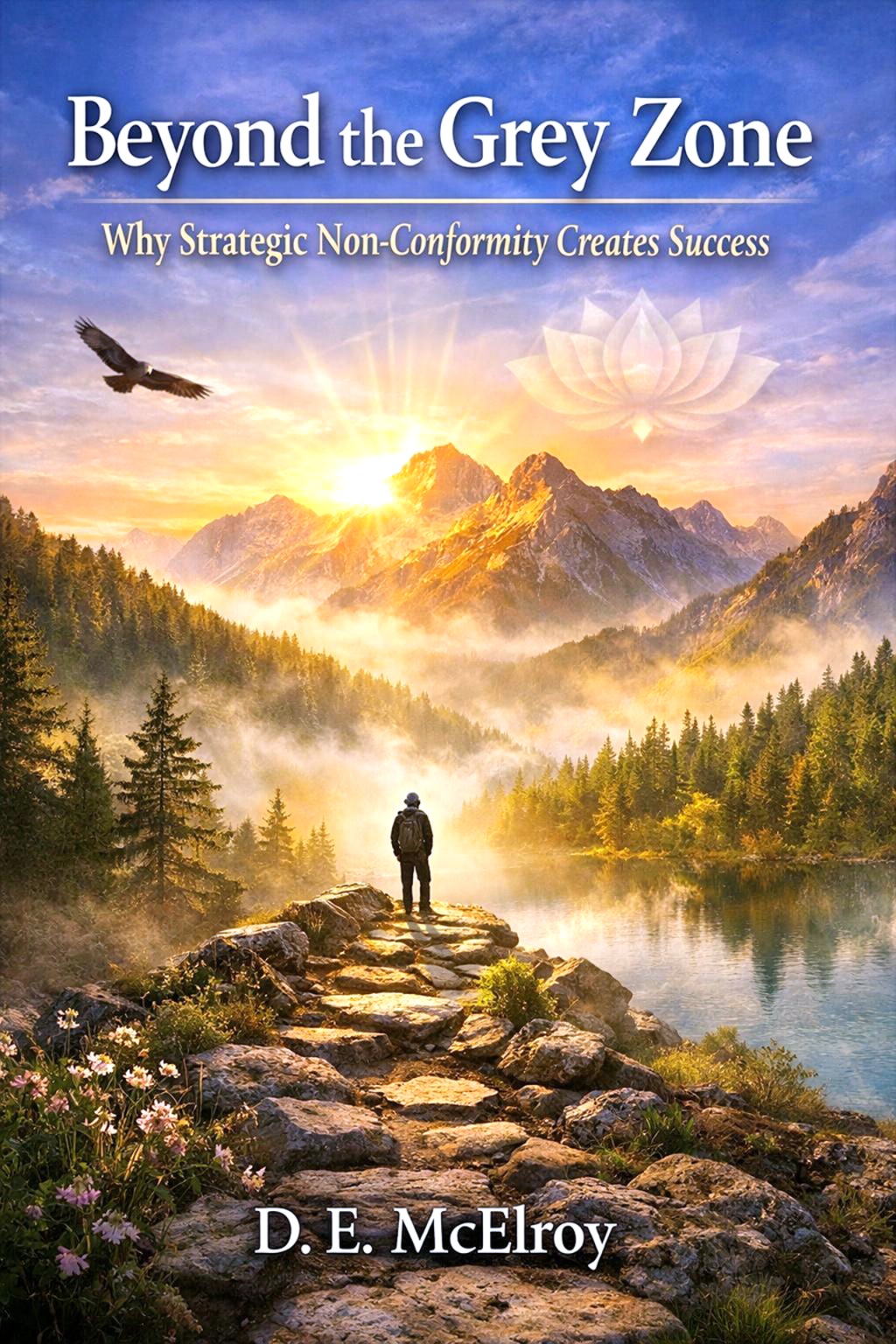
Beyond the Grey Zone:
Why Strategic Non-Conformity Creates Success
A Mini Book
Introduction
Why This Book Matters
Most people never question the path they are on.
They go
to school.
They get a job.
They work hard.
They follow the rules.
And there is nothing wrong with that.
But at some point, many people feel something deeper.
A quiet restlessness.
A sense that they are capable of more.
Not more
money only.
Not more status.
More
ownership.
More independence.
More meaning.
This book is not about attacking people who work regular jobs.
It is not about rebellion.
It is about thinking.
It is about noticing when comfort becomes limitation.
It is about understanding the difference between living safely inside a system and learning how to build something of your own.
Some people live in what I call the Grey Zone.
Others learn to step beyond it.
The difference is not personality.
It is the choice to think and act for yourself.
I did not leave my steady government job overnight.
I built something on the side.
I learned skills.
I took careful risks.
I grew step by step.
This book will not tell you to gamble your future.
It will invite you to examine it.
If you are fully satisfied where you are, this book may simply confirm your path.
But if you feel capable of more…
Then this book is for you.
Let us begin.
↑ Back to Table of ContentsChapter 1
The Grey Zone
Most people live in what I call the Grey Zone.
The Grey Zone is not bad. It is not evil. It is not lazy.
It is safe.
In the
Grey Zone, life is predictable.
You go to school.
You get a job.
You work hard.
You follow the rules.
You wait for raises.
You count the days to Friday.
Many people in the Grey Zone are good people. They are responsible. They show up on time. They care about their families. They do what is expected.
But something is missing.
The Grey Zone is built on security, not possibility.
In this zone, most decisions are made by someone else:
- Your boss sets the goals.
- The company sets the pay.
- The system sets the limits.
- The culture sets the “right way” to think.
You may work hard for 30 years and still feel like you never truly built something of your own.
Many people live paycheck to paycheck, even while working full time. They trade time for money. When time stops, income stops.
Again, this is not a judgment.
It is a pattern.
The Grey Zone rewards people who follow instructions well. It does not reward people for asking bold questions.
Over time, something quiet happens.
Talents
go unused.
Ideas stay unspoken.
Dreams shrink to fit the system.
The Grey Zone is comfortable.
But comfort and growth are rarely the same thing.
So here is the first question of this book:
Are you building your life — or are you maintaining someone else’s system?
Reflection Questions
- In what areas of my life am I choosing comfort over growth?
- Am I building something of my own, or only maintaining someone else’s system?
- What talents might I be leaving unused?
- Do I feel secure — or do I feel stuck?
Chapter 2
Why Conformity Feels So Comfortable
If the Grey Zone limits growth, why do so many people stay there?
Because it feels safe.
From a young age, we are trained to conform.
In school:
- Sit still.
- Raise your hand.
- Give the “right” answer.
- Follow instructions.
Students
who follow directions are rewarded.
Students who question too much are often labeled as
difficult.
Then we enter the workplace.
Companies want:
- Stability.
- Predictable results.
- Employees who follow the process.
This makes sense. Businesses need order to survive.
But over time, something else happens.
We learn to wait for permission.
Permission to:
- Try something new.
- Suggest a different idea.
- Take a risk.
- Build something of our own.
Conformity
reduces risk.
It also reduces responsibility.
If things go wrong, you can say, “I was just doing my job.”
That feels safe.
But safety has a cost.
When you always wait for direction, you stop practicing independent thinking.
When you always follow the system, you never learn how to build one.
The Grey Zone is comfortable because it removes uncertainty.
But success — especially entrepreneurial success — requires stepping into uncertainty.
Not recklessly.
Not foolishly.
But deliberately.
Comfort keeps you steady.
Growth requires movement.
And movement begins with a simple shift:
Stop asking, “What am I allowed to do?”
Start asking, “What can I create?”
Reflection Questions
- Where in my life do I wait for permission?
- Do I avoid risk because of fear, or because of wisdom?
- Have I trained myself to follow — or to think?
- When was the last time I questioned the “normal way” of doing something?
Chapter 3
The Myth of the Rebel
When people hear the word “non-conformist,” they often picture a rebel.
Someone
loud.
Someone angry.
Someone who breaks rules just to prove a point.
That is not what this book is about.
Breaking
rules does not make someone successful.
Complaining about the system does not build anything new.
True non-conformists are different.
They are thinkers.
They
study the system.
They understand how it works.
Then they look for ways to improve it — or build something
better.
They do
not reject structure.
They redesign it.
They do
not hate rules.
They question whether the rules still make sense.
A
reckless rebel creates noise.
A strategic non-conformist creates value.
That is a big difference.
Some of the most successful entrepreneurs in the world were not wild rule-breakers. They were careful observers.
They noticed:
- What people needed.
- What was outdated.
- What could be done faster.
- What could be done smarter.
Then they acted.
Non-conformity is not about being different for attention.
It is about thinking independently on purpose.
You do not have to shout to stand apart.
You simply have to think for yourself.
Reflection Questions
- Do I confuse independence with rebellion?
- Do I complain about systems — or try to improve them?
- Am I building value, or just criticizing?
- What problem do I see that I could help solve?
Chapter 4
Adaptability: The Real Advantage
The world changes fast.
Technology
changes.
Markets change.
Customer needs change.
Jobs change.
People who depend only on stability often struggle when change comes.
They wait
for instructions.
They wait for training.
They wait for someone else to solve the problem.
Strategic non-conformists respond differently.
They ask:
- What is changing?
- How can I adjust?
- Where is the opportunity?
Adaptability
is not talent.
It is a habit.
It means:
- Learning new skills.
- Letting go of old methods.
- Staying curious.
- Moving when others freeze.
In business, adaptability creates advantage.
When
others say, “This is how we’ve always done it,”
the adaptive thinker asks, “Is there a better way?”
This does not mean constant chaos.
It means being willing to evolve.
Companies fail when they refuse to change.
People struggle when they refuse to grow.
The future does not reward the most obedient.
It rewards the most adaptable.
If you can adjust faster than the average person, you will see opportunities others miss.
And opportunity is where success begins.
Reflection Questions
- How well do I respond to change?
- Do I resist new ideas because they are uncomfortable?
- What skill could I learn this year that would increase my options?
- When change happens, do I freeze — or adjust?

Chapter 5
The Hybrid Mind
Some people think you must choose.
Either
you play it safe.
Or you take a big risk.
But that is not true.
The most successful people often do both — at the same time.
They work
inside the system.
While quietly building outside of it.
For many years, I worked a government job.
It was
steady.
It paid the bills.
It gave my family stability.
On the outside, I looked like a conformist.
But something happened that changed my path.
I was treated unfairly by a supervisor. I went to the Union to file a grievance. The Union Representative was on his last day.
I asked him, “How do you become a Union Rep?”
He invited me to a meeting that night.
The next day, I was the new Union Rep.
Now I had two roles.
By day, I worked my government job.
But as a Union Rep, I defended employees against management when they were treated unfairly.
It woke me up.
The boredom was gone.
Within three years, I rose from Union Rep to:
- Leader over 20 Union Representatives
- Chairman of Negotiations
- Vice President of the Union Chapter
- Acting President at times
All while still working my regular government job.
I was learning leadership, negotiation, public speaking, and strategy.
The government job gave me stability.
The Union role gave me growth.
That is the hybrid mind.
Conform when it serves you.
Build when it empowers you.
Reflection Questions
- How could I use my current job as a foundation instead of a prison?
- What side interest could I quietly begin developing?
- What leadership skills am I capable of growing?
- Where have I underestimated myself?
Chapter 6
Building Beyond the Grey Zone
My mother once told me:
“A government job will give you stability for a while, but you can start your own business on the side and eventually leave the boring job.”
I never forgot that.
So I started small.
After work and on weekends, I performed wedding ceremonies.
Sometimes
in the city.
Sometimes as far away as Yosemite National Park.
Over time, I performed about 2,500 ceremonies.
The extra income allowed my wife, daughter, and me to move into a safer neighborhood — right next to the elementary school my daughter was about to attend.
But something interesting happened.
The house we moved into was only one street away from friends we had made years earlier while living in a small apartment.
Even more surprising, it was right across the street and two houses down from a young woman I worked with at my government job.
We suddenly had support around us.
Familiar
faces.
Trusted friends.
Community.
That same coworker later became the godmother of our second daughter.
You can call that coincidence.
Or you can say something bigger was at work.
Sometimes when you begin moving forward, doors open that you did not plan.
Eventually, I was earning more from weddings than from my government job.
But I did not quit right away.
I kept building.
Later, I became tired of constant travel. So I shifted again.
Instead of only performing weddings, I began ordaining others so they could perform weddings too.
I wrote
handbooks.
I created courses.
I offered more than simple ordination.
The business grew beyond what I expected.
After 19 years with the government, I took a one-year leave of absence to test the business.
It continued to grow.
In my 20th year, I resigned.
I never looked back.
Over time, I was earning three to four times what the government job paid me.
But here is something important:
The government job taught me useful skills.
I taught
new employees in classroom settings.
I created desk procedures.
I learned word processing and computer skills.
Nothing was wasted.
Strategic non-conformity does not mean rejecting everything.
It means using everything.
Eventually, after many years of successful work, I retired.
Not rich.
But comfortable.
In an older mountain home, with wildlife sometimes walking by.
And now I create Mini Books and new ideas — not because I have to, but because I want to.
That is the goal.
Not rebellion.
Not ego.
Freedom.
Freedom built step by step.
Beyond the Grey Zone.
Reflection Questions
- What small step could I take this month toward independence?
- Who around me could become part of my support system?
- Am I waiting for perfect timing — or can I begin now?
- What would freedom look like for me personally?
Chapter 7
How to Step Out Without Blowing Up Your Life
Stepping beyond the Grey Zone does not mean quitting your job tomorrow.
It does not mean risking everything at once.
It means thinking differently first.
Here are simple ways to begin.
1. Start Small
You do not need a giant plan.
You need a small action.
- Take a class.
- Start a side project.
- Offer a service.
- Learn a skill.
- Test an idea.
Small steps build confidence.
Confidence builds courage.
2. Keep Stability While You Build
Security is not your enemy.
It can be your foundation.
Your job can fund your future.
Your steady income can support your experiments.
You do not have to choose between safety and growth.
You can use one to build the other.
3. Develop Useful Skills
Ask yourself:
- Can I lead?
- Can I teach?
- Can I negotiate?
- Can I solve problems?
- Can I communicate clearly?
Skills give you options.
Options give you freedom.
Every skill you gain increases your value — whether you stay in a job or build your own path.
4. Learn to Notice Opportunity
Opportunity rarely announces itself.
It shows up as:
- A problem people complain about.
- A gap no one has filled.
- A skill you already have.
- A need you understand.
Pay attention.
Most people see inconvenience.
Entrepreneurs see possibility.
5. Take Smart Risks, Not Wild Risks
There is a difference between reckless and strategic.
Reckless risks ignore consequences.
Strategic risks are measured.
Ask:
- What is the downside?
- Can I survive it?
- What can I learn even if I fail?
Growth always involves uncertainty.
But it does not require chaos.
Stepping beyond the Grey Zone is not a jump.
It is a series of steps.
Taken consistently.
Over time.
Reflection Questions
- What is one small action I can take in the next 30 days?
- What is the real risk — and is it truly as big as I imagine?
- What skill should I begin strengthening immediately?
- If I do nothing different, where will I be in five years?
Chapter 8
The Final Invitation
This book is not an attack on conformists.
It is not a command to quit your job.
It is an invitation.
An invitation to think.
An invitation to examine your life.
An invitation to ask:
- Am I growing?
- Am I building something of my own?
- Am I using my talents?
- Am I preparing for change?
- Am I thinking for myself?
Some people are perfectly content in structured systems.
That is fine.
But if
you feel restless…
If you feel capable of more…
If you sense that you are meant to create, not just comply…
Then listen to that voice.
The world does not need more noise.
It needs more thoughtful builders.
It needs people who:
- Adapt.
- Create value.
- Lead with calm strength.
- Improve what already exists.
You do not have to reject the system.
But you do not have to be limited by it either.
The Grey Zone is safe.
But beyond it is growth.
Beyond it is ownership.
Beyond it is freedom.
The choice is not about personality.
It is about whether you are willing to think and act for yourself.
One careful step at a time.
Beyond the Grey Zone.
Reflection Questions
- Am I satisfied — or simply comfortable?
- What does “success” actually mean to me?
- What would thinking for myself look like in real life?
- Am I ready to step beyond the Grey Zone?