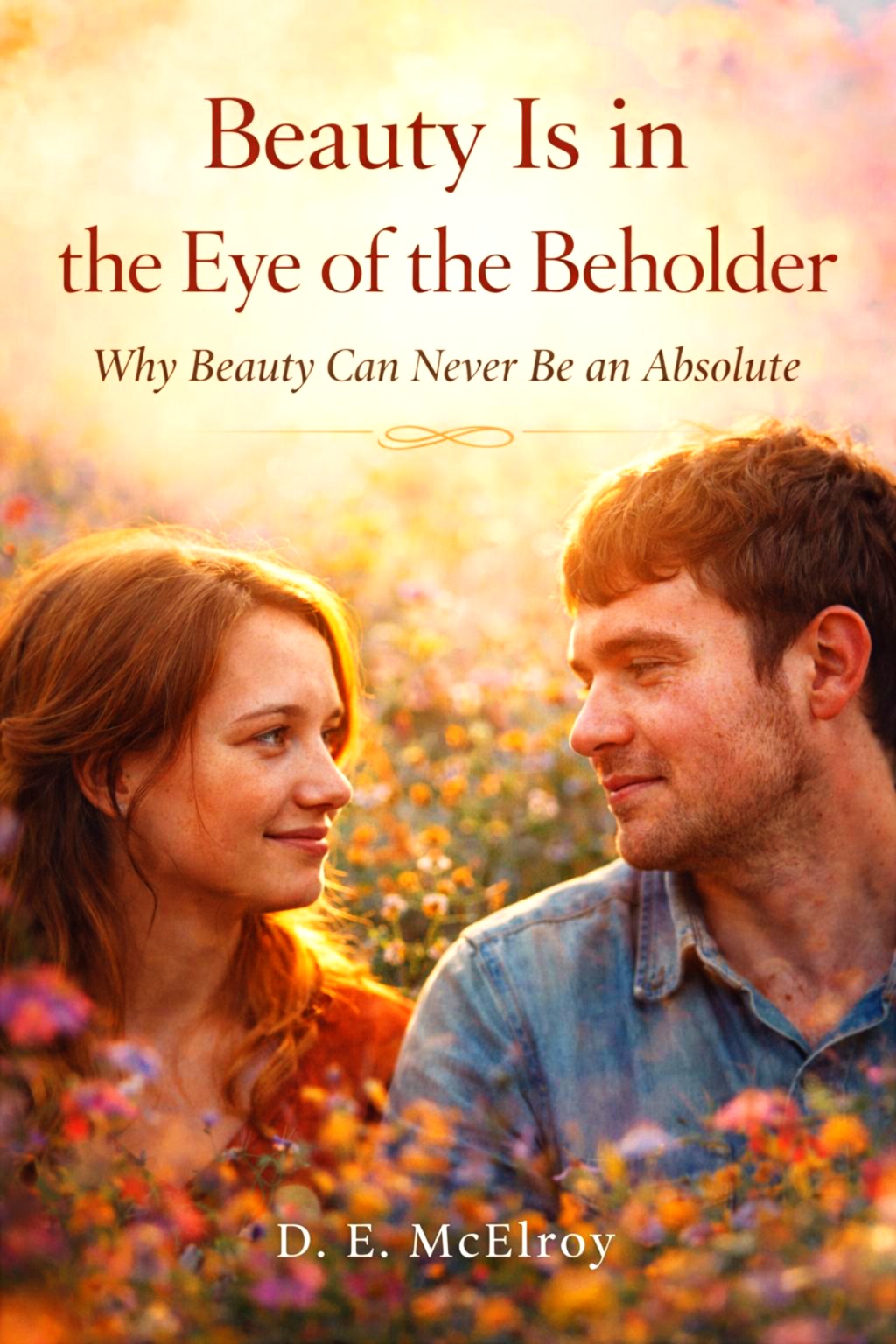
Beauty Is in the Eye of the Beholder
Author: D. E. McElroy
Table of Contents
- Introduction
- Chapter 1 — The Saying We Repeat Without Examining
- Chapter 2 — Beauty Beyond Appearance
- Chapter 3 — How Perception Shapes What We See
- Chapter 4 — When Attraction Is Mistaken for Beauty
- Chapter 5 — How Culture Teaches Us What to Call Beautiful
- Chapter 6 — When Experience Redefines Beauty
- Chapter 7 — Seeing Beauty in Actions and Choices
- Chapter 8 — When We Turn the Lens on Ourselves
- Chapter 9 — Beauty as Recognition, Not Measurement
- Epilogue — Learning to See
- About the Author
Introduction
Beauty is often spoken of as though it were a fixed and measurable fact—something that can be ranked, agreed upon, and universally recognized. Yet lived experience consistently contradicts this idea. What one person finds beautiful, another may not. What captivates at one stage of life may feel empty at another. These shifts reveal something essential: beauty is not only about what is seen, but about the one who is seeing.
This Mini Book explores the familiar phrase “Beauty is in the eye of the beholder” not as a casual saying, but as a profound insight into perception. Beauty includes physical appearance, but it also includes inner qualities such as kindness, sincerity, steadiness, and even the beauty found in actions, choices, and meaningful moments.
When beauty is examined honestly, comparison loosens its grip. People stop being ranked. Worth is no longer outsourced to trends or approval. Beauty becomes less about being impressed and more about recognizing what is real.
The purpose of this book is not to deny physical attraction or dismiss appearances, but to expand awareness—so beauty can be seen more clearly, compassionately, and truthfully.
Chapter 1 — The Saying We Repeat Without Examining
“Beauty is in the eye of the beholder” is one of those sayings people repeat easily, often without stopping to consider what it truly means. It is usually spoken as a polite way to end disagreement, not as a serious observation about perception. Yet beneath its casual use lies a profound truth about how human beings see, judge, and assign value.
From an early age, most of us are taught—implicitly and explicitly—that beauty can be defined. Faces, bodies, voices, art, and even lifestyles are ranked according to standards that appear fixed and authoritative. These standards are reinforced through culture, advertising, media, and social approval, until they begin to feel objective—as though beauty exists independently of the person doing the seeing.
And yet, experience quietly contradicts this idea. What one person finds beautiful, another may find unremarkable or even unattractive. What dazzles at one stage of life may feel empty at another. These shifts are not random; they reflect changes in perception rather than changes in the object itself.
If beauty were truly absolute, it would not change with time, maturity, experience, or emotional growth. The same face, the same form, the same presence would evoke the same response in everyone, always. That this does not occur suggests that beauty is not a fixed property, but a relationship—one shaped by awareness, values, memory, and inner development.
This book begins with a simple invitation: pause and look again at what we call beauty. Not to deny physical appearance, but to question whether the eye alone is capable of seeing what truly matters. When we examine beauty honestly, we may discover that what we were taught to admire is not always what our deeper selves were seeking.
Chapter 2 — Beauty Beyond Appearance
When people speak of beauty, they often assume the subject is physical appearance. Faces, bodies, symmetry, and outward traits tend to dominate the conversation, especially in youth and in cultures saturated with visual imagery. Yet even in everyday language, humans regularly acknowledge a different kind of beauty—one that has nothing to do with how something looks.
We say a kind act was beautiful. We describe forgiveness as beautiful. We recognize beauty in courage, in restraint, in compassion offered quietly without recognition. These uses of the word are not poetic accidents; they reflect an intuitive understanding that beauty can arise from character, intention, and choice. In these moments, beauty is perceived not by the eyes alone, but by the heart and conscience.
Inner beauty reveals itself over time. Unlike physical attraction, which is often immediate, inner beauty unfolds gradually through consistency, kindness, patience, and emotional safety. It is recognized in how someone treats others, especially when no reward is expected. This form of beauty does not demand attention, yet it leaves a lasting impression because it nurtures rather than excites.
Beauty can also appear within situations themselves. A difficult decision made with integrity, a painful truth spoken gently, or a moment of growth that follows hardship can all be described as beautiful. In these cases, beauty emerges not from pleasure, but from meaning.
Recognizing beauty beyond appearance changes how we evaluate people and experiences. It shifts attention away from surface traits and toward substance. When beauty is understood as something that can exist in character, actions, and moments of moral clarity, it becomes clear that beauty is not fixed or absolute. It is perceived through awareness—and awareness itself evolves.
Chapter 3 — How Perception Shapes What We See
Beauty is not perceived in isolation. It is filtered through memory, emotion, experience, and awareness. What we call “seeing” is rarely a neutral act; it is interpretation shaped by who we are at a given moment in life. Two people can look at the same person, situation, or event and walk away with entirely different impressions of beauty—not because one is right and the other wrong, but because perception itself differs.
In youth, perception is often guided by external validation. What is admired by peers, celebrated by culture, or rewarded socially tends to shape attraction. Beauty becomes associated with approval, excitement, and belonging. At this stage, the eye is trained more by outside voices than by inner discernment, and what stands out visually is often mistaken for what matters most.
As experience accumulates, perception begins to change. Disappointment, growth, love, and loss quietly reeducate the senses. Traits that once seemed insignificant—kindness, reliability, emotional steadiness—begin to stand out, while surface appeal loses its authority. The eye learns what the heart already knows: beauty without substance rarely sustains.
This shift does not happen all at once. It unfolds gradually, often recognized only in hindsight. Many people look back on earlier choices and realize that what once attracted them no longer holds meaning. This is not a failure of judgment; it is evidence of growth. Perception matures as awareness deepens.
When beauty is understood as something shaped by perception, it can no longer be absolute. It becomes relational—dependent on the beholder’s values, consciousness, and stage of life. The eye sees what the inner world is prepared to recognize. As that inner world changes, so too does what appears beautiful.
Chapter 4 — When Attraction Is Mistaken for Beauty
Attraction often arrives before understanding. It is immediate, sensory, and emotionally charged, which makes it easy to confuse with beauty itself. Especially in earlier stages of life, attraction can feel decisive, as though it reveals something essential. Yet attraction does not always point toward what is nourishing or enduring.
Cultural conditioning plays a powerful role in shaping attraction. Images repeatedly presented as desirable begin to feel authoritative, even when they do not align with deeper needs. Over time, people may find themselves drawn to what is celebrated rather than what is compatible. In such cases, attraction reflects learned preference more than genuine recognition.
Many people discover this distinction only after experience has done its work. Relationships formed on surface appeal often reveal their limitations over time. What initially felt exciting may lack emotional depth, stability, or kindness. In contrast, qualities once overlooked—gentleness, patience, sincerity—emerge as sources of lasting beauty.
Recognizing the difference between attraction and beauty can be uncomfortable, especially when it involves revisiting past choices. Yet this recognition is not meant to produce regret. It is meant to produce understanding. Awareness grows through contrast, and clarity often arrives only after experience has revealed what attraction alone could not.
When attraction is no longer mistaken for beauty, perception shifts. The eye becomes quieter, less reactive, and more discerning. Beauty begins to register not in how strongly something pulls, but in how deeply it resonates. At that point, beauty is no longer about being impressed—it is about being at home.

Chapter 5 — How Culture Teaches Us What to Call Beautiful
Long before we choose for ourselves, we are taught what beauty is supposed to look like. Culture provides templates—faces, bodies, styles, and personalities—that are repeatedly reinforced through media, advertising, and social approval. Over time, these images begin to feel natural rather than taught, even though they are neither universal nor timeless.
Because these standards are external, they often reward what is immediately noticeable rather than what is meaningful. Youth, novelty, charm, and ease are emphasized, while depth, character, and kindness are treated as secondary or invisible. This imbalance trains the eye to prioritize impression over substance, especially during formative years.
The influence of culture can be so subtle that people assume their preferences are entirely personal. Yet when many individuals are drawn to the same narrow definitions of beauty, it becomes clear that conditioning is at work. What feels like individual taste is often a reflection of repeated exposure rather than genuine recognition.
As awareness grows, many people begin to sense a mismatch between what they are attracted to and what actually brings fulfillment. The images that once guided desire lose their authority, and previously overlooked qualities begin to register as beautiful. This shift is not rebellion against culture; it is maturation beyond it.
When cultural conditioning loosens its grip, beauty becomes less about fitting an image and more about alignment with values. The beholder begins to see differently—not because the world has changed, but because the lens through which it is viewed has become clearer.
Chapter 6 — When Experience Redefines Beauty
Experience has a way of quietly revising what we value. Lessons that cannot be taught abstractly are learned through relationships, choices, and outcomes. Over time, life reveals that what initially attracts us does not always sustain us, and what sustains us is often something we once overlooked.
Many people come to recognize that certain forms of beauty are fragile. Charm without depth fades. Ease without commitment collapses under pressure. What once seemed exciting may later feel empty or unstable. These realizations do not arrive as judgments, but as understandings earned through living.
In contrast, qualities such as kindness, emotional steadiness, sincerity, and patience often reveal their beauty gradually. They become visible not in moments of excitement, but in moments of difficulty. When challenges arise, inner beauty shows itself through consistency and care rather than performance.
This process of redefinition can be bittersweet. Looking back, people sometimes recognize crossroads where different choices might have led to different outcomes. Yet these reflections are not meant to produce self-criticism. They mark the point at which perception matured enough to see clearly.
When experience redefines beauty, attraction is no longer governed by appearance alone. Beauty becomes associated with trust, safety, and shared values. At that stage, what is beautiful is not what impresses the eye, but what allows the soul to rest.
Chapter 7 — Seeing Beauty in Actions and Choices
As perception matures, beauty is no longer confined to people alone. It begins to appear in actions, decisions, and moments where character is revealed. A quiet act of kindness, a difficult truth spoken with care, or a choice made with integrity can evoke a sense of beauty that has nothing to do with appearance.
This form of beauty is often subtle. It does not demand attention or admiration, and it frequently goes unnoticed by those focused on surface impressions. Yet it leaves a lasting impact, because it affirms something deeply human—the capacity to choose compassion, restraint, and understanding even when doing so is not easy.
People instinctively recognize this kind of beauty when they say, “That was a beautiful thing to do.” In these moments, beauty is felt rather than analyzed. It arises from alignment between intention and action, from the sense that something meaningful has occurred even if no one was watching.
Situations themselves can carry beauty when they reflect growth or moral clarity. A reconciliation after conflict, a moment of forgiveness, or the courage to walk away from what no longer serves can all be experienced as beautiful. These moments often emerge from hardship rather than comfort.
When beauty is recognized in actions and choices, judgment softens. The beholder becomes less concerned with how things appear and more attentive to how they unfold. Beauty, in this sense, becomes a measure of integrity rather than aesthetics—a recognition that what is most meaningful often reveals itself quietly.
Chapter 8 — When We Turn the Lens on Ourselves
One of the most difficult places to recognize beauty is within ourselves. Cultural standards and early conditioning often teach people to judge themselves more harshly than they judge others. Physical appearance, perceived shortcomings, and past mistakes can obscure inner qualities that would be recognized as beautiful if seen in someone else.
Many people carry an internalized image of how they were “supposed” to look, live, or succeed. When reality diverges from that image, self-criticism takes root. Beauty becomes something external—something to be earned or proven—rather than something already present in character, effort, and intention.
Yet when the same lens used to recognize beauty in others is turned inward, a different picture emerges. Acts of perseverance, kindness shown under strain, growth after loss, and the courage to continue despite disappointment all reflect a form of beauty that is rarely acknowledged. This beauty is quiet, but it is real.
Learning to see oneself with compassion does not mean ignoring flaws or avoiding responsibility. It means recognizing that beauty includes imperfection, learning, and change. A life honestly lived, even with missteps, carries its own dignity. That dignity is a form of beauty often overlooked because it does not conform to external ideals.
When the beholder learns to recognize beauty within, comparison loses much of its power. Self-worth becomes grounded in lived integrity rather than appearance or approval. At that point, beauty is no longer something sought—it is something recognized, both in oneself and in others.
Chapter 9 — Beauty as Recognition, Not Measurement
Modern culture encourages people to measure beauty—to rank it, compare it, and assign value as though it were a fixed commodity. Numbers, likes, opinions, and standards replace lived experience, and beauty becomes something to be evaluated rather than recognized. In this framework, worth is determined externally, and comparison becomes inevitable.
Yet the most meaningful experiences of beauty are rarely measured. They are recognized intuitively, often without explanation. A moment of understanding, a gesture of compassion, or a quiet act of courage does not need validation to be felt as beautiful. Its value is intrinsic, not assigned.
When beauty is treated as recognition rather than measurement, judgment softens. The need to compete diminishes, and the pressure to conform eases. Beauty is no longer something one possesses more or less of, but something one perceives when awareness is present. The beholder’s state of mind becomes more important than the object being observed.
This shift has practical consequences. People who stop measuring beauty become less reactive and more receptive. They listen more closely, appreciate more deeply, and feel less compelled to prove themselves. Relationships benefit when beauty is recognized in sincerity rather than appearance, and communities become more humane when worth is not tied to superficial standards.
Understanding beauty as recognition allows it to expand. It appears in unexpected places—in aging, in vulnerability, in growth, and in restraint. When beauty is no longer confined to form or comparison, it becomes accessible to everyone. It is no longer something to be attained, but something to be seen.
Epilogue — Learning to See
Over the course of a lifetime, what we call beauty quietly changes. What once impressed the eye may later feel hollow, while what once went unnoticed begins to glow with meaning. These changes do not reflect inconsistency; they reflect growth. As awareness deepens, perception becomes more honest.
Beauty, when examined closely, reveals itself not as an object to be possessed, but as a relationship between the beholder and what is seen. It arises when awareness meets sincerity, when attention meets substance. In this sense, beauty is less about appearance and more about recognition.
The saying “beauty is in the eye of the beholder” is not a dismissal of beauty, but an invitation to maturity. It reminds us that what we see is shaped by who we are. As we change, our perception changes—and with it, our understanding of what truly matters.
When beauty is freed from rigid definitions, comparison loses its grip. People are no longer ranked, moments are no longer measured, and worth is no longer assigned by external standards. Beauty becomes something shared rather than competed for, something felt rather than proven.
Learning to see in this way does not require perfection or special insight. It requires only attentiveness, honesty, and compassion. When these qualities guide perception, beauty appears in places it was never taught to look—in character, in actions, in growth, and in the quiet dignity of lives honestly lived.
About the Author
D. E. McElroy is the founder of World Christianship Ministries (WCM) and the author of works exploring compassion, consciousness, and practical wisdom for daily living.
His writing focuses on clarity, dignity, and awareness.
Website: https://wcm.org
© 2026 D. E. McElroy / World Christianship
Ministries